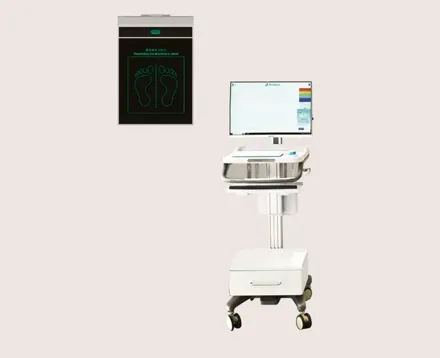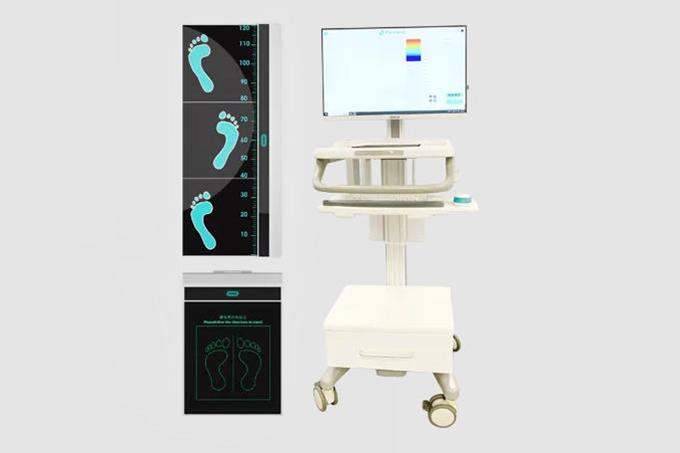
Plantar pressure measurement devices are used to quantify how pressure is distributed beneath the feet during standing, walking or other functional activities. For rehabilitation departments, podiatry clinics, biomechanics laboratories and sports medicine facilities, these devices can provide objective information about loading patterns that may be difficult to quantify through visual observation alone.
However, devices differ considerably in sensing technology, measurement area, sampling frequency, software output and intended use. A suitable plantar pressure system should therefore be selected according to the clinical task rather than simply by comparing the number of sensors or the headline specification.
Understanding the major device types and performance parameters can help buyers make a more practical purchasing decision.
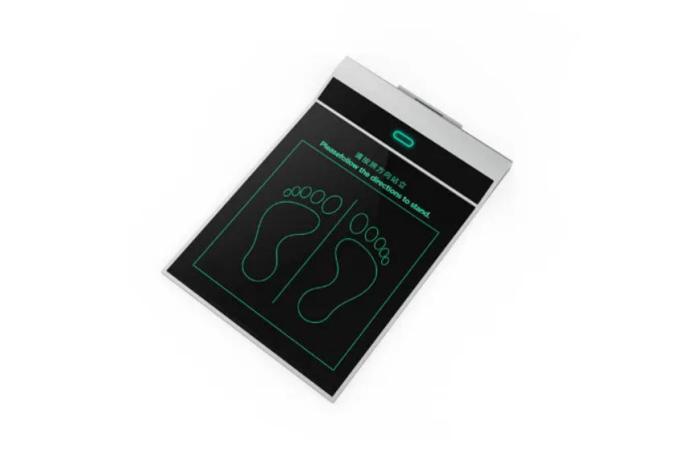
Plantar pressure measurement devices are sensor-based instruments that record the magnitude and distribution of pressure between the foot and a measurement surface.
The sensing surface may be integrated into a floor platform, walkway or instrumented insole. As the patient stands or moves, each plantar pressure sensor responds to local loading and sends data to software for processing.
The resulting information may include peak pressure, mean pressure, contact area, left-right loading, center-of-pressure movement and temporal gait parameters.
These systems should not be viewed simply as devices that create colorful footprints. Their main clinical value lies in turning foot-ground interaction into measurable data that can be repeated and compared over time.
A 2024 review of plantar pressure measurement technologies also emphasizes that device selection should consider calibration, testing protocols and intended application rather than technical specifications in isolation.
The main types of plantar pressure measurement devices are platform-based systems and in-shoe systems, with each format serving different assessment conditions.
A platform system is positioned on the floor and records the foot as the patient stands or walks across it. It is particularly useful for controlled barefoot assessment, static balance testing and laboratory-style gait evaluation.
In-shoe systems place sensors inside footwear. They can record multiple steps under more natural walking conditions and are particularly useful when clinicians need to examine the effects of shoes, insoles or orthoses.
| Device Type | Best Suited For | Main Advantage | Main Limitation |
|---|---|---|---|
| Static pressure platform | Standing and balance | Controlled bilateral measurement | Limited dynamic assessment |
| Dynamic pressure platform | Walking and gait | Detailed spatial and temporal data | Requires appropriate walking space |
| In-shoe device | Footwear and real-world movement | Multiple-step measurement | Often lower spatial resolution |
| Combined system | Multi-purpose clinics | Static + dynamic workflow | Higher equipment complexity |
The same review found that rigid platforms are generally well suited to controlled plantar pressure assessment, while in-shoe systems are particularly useful for studying footwear and multiple steps.
The right format therefore depends on whether the clinical priority is balance, gait, footwear evaluation or a combination of these tasks.
Key specifications of plantar pressure measurement devices include sensor density, sampling frequency, measurement range, accuracy, platform size and software output.
Buyers should pay particular attention to:
Sensor density and sensing area: Higher spatial resolution can provide more detailed regional pressure information, but sensor quality and calibration are equally important.
Sampling frequency: Dynamic gait requires sufficient temporal resolution to capture rapid pressure changes.
Measurement range: The system should accommodate the intended patient population without operating near its limits.
Accuracy and repeatability: Measurements must remain sufficiently consistent for follow-up comparison.
Software metrics: Reports should include clinically relevant variables rather than simply generating large amounts of unused data.
Platform dimensions: The usable measurement surface should match the intended standing or walking protocol.
For perspective, Sighture's static Gaitnovate I specification lists 4,096 sensing points, scanning of at least 800 Hz, a 10–200 kg measurement range and stated accuracy of ±2% full scale. These numbers are useful as examples of the types of specifications buyers should compare, rather than as universal thresholds for every clinic.
Plantar pressure measurement devices support clinical assessment by quantifying loading, balance and gait characteristics during different functional tasks.
Typical applications include rehabilitation monitoring, gait assessment, balance evaluation, orthotic assessment and analysis of regions exposed to elevated plantar loading.
For example, after lower-limb injury, repeated foot pressure measurement may help determine whether weight-bearing symmetry changes during rehabilitation. In orthotic assessment, measurements taken before and after an intervention can show whether pressure has shifted away from a targeted region.
These devices may also support diabetic-foot assessment, sports biomechanics and research. However, pressure data should always be interpreted together with symptoms, medical history, joint function and other clinical findings.
Consistency is especially important for longitudinal monitoring. Changing the device, calibration method or testing protocol between visits can make comparison less reliable.
The cost of plantar pressure measurement devices depends on hardware configuration, sensor technology, software capabilities, clinical accessories and support rather than on one fixed market price.
A basic static platform will usually have a different cost structure from a high-frequency dynamic walkway or a system combining static and dynamic assessment. Sensor count and measurement area can influence price, but they are only part of the total investment.
Software is another major factor. Some systems focus on basic pressure maps, while others calculate arch indices, center-of-pressure trajectories, gait timing and automated reports.
Buyers should also consider calibration, computer requirements, installation, staff training, warranty and after-sales service. For hospital procurement, the most useful comparison is therefore total cost of ownership, not just initial hardware price.
Before requesting quotations, clinics should define the required patient population, test type, measurement area, report parameters and expected daily usage. This makes different plantar pressure measurement devices much easier to compare on the same basis.
Choosing the right plantar pressure measurement devices requires matching device type and technical performance to the intended clinical workflow. Sensor density, sampling frequency, accuracy, measurement range, software and repeatability should all be reviewed together.
A static plantar pressure system may be sufficient for balance-focused assessment, while gait-focused clinics may require dynamic measurement or a combined solution. The best purchase is therefore not necessarily the device with the highest specification, but the one that consistently produces clinically useful data for the assessments a facility actually performs.
They measure pressure distribution, contact area, loading symmetry and other foot-ground interaction parameters.
It is a sensor that converts mechanical pressure beneath the foot into measurable data.
Neither is universally better. Platforms suit controlled testing, while in-shoe systems are useful for footwear and multiple-step assessment.
Not necessarily. The required rate depends on the movement being studied and the clinical purpose.
Hardware, sensor configuration, measurement area, software, accessories, training and support all affect total cost.
Compare device type, accuracy, repeatability, sensor performance, software metrics, workflow, support and total ownership cost.

 English