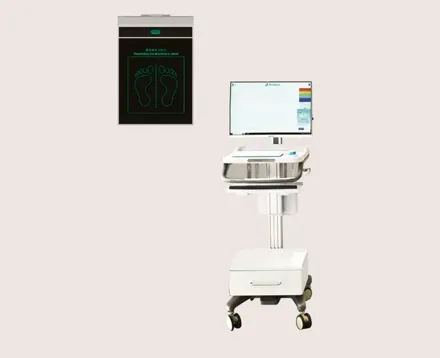
For decades, lower-limb assessments relied heavily on what a clinician could observe with the naked eye. You watch a patient walk across the room. You note where the calluses sit. You palpate, you ask questions, and you make a judgment call. It works—until it doesn't. The problem is that the human eye simply cannot catch what happens in the 600 to 800 milliseconds that make up a single stance phase. Too much data rushes by too fast.
That blind spot is precisely where plantar pressure mapping steps in—and it is fundamentally reshaping how rehabilitation specialists, podiatrists, and sports medicine teams understand the foot in motion. Think of it less as a diagnostic gadget and more as a functional MRI for the walking patient: it reveals load patterns, asymmetries, and risk zones that visual observation alone would never detect.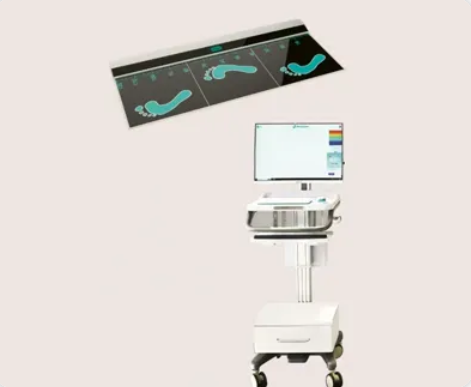
The core principle behind a plantar pressure system is straightforward. In practice, a patient walks across a sensor mat or wears slim sensor insoles inside their regular footwear. Either way, the system captures how pressure distributes across the sole of the foot at every millisecond of contact. High-end clinical platforms—such as Sighture Medical's Plantar Pressure Gait Analysis System—sample at 800 Hz, meaning they record 800 data snapshots per second. That sampling speed makes it possible to catch micro-events that slower systems blur together, such as a subtle forefoot slap or a momentary lateral weight shift.
Raw sensor data then flows into software that converts it into a color-coded heat map: red zones mark peak loading, blue zones indicate minimal contact. But modern systems go well beyond pretty pictures. They calculate the center of pressure trajectory, track its mediolateral sway, and measure step-to-step symmetry across an entire gait cycle . The output is a quantitative biomechanical profile that clinicians can track session by session.
An important distinction needs to be made between barefoot platform testing and in-shoe measurement. Barefoot mapping captures what the foot does without external interference—useful for identifying structural risk zones. In-shoe mapping, by contrast, shows how footwear and orthotics actually modify those loads in real-world walking. Research published in the Journal of Biomechanics (2026) found that while barefoot data can flag very high localized pressures in the toes, those same regions often show much lower loading inside a shoe, with contact areas spreading outward. The two methods complement each other, but neither tells the whole story on its own .
There is a quietly dangerous assumption baked into visual gait assessment: that "looks normal" equals "loads normal." Plenty of patients compensate so smoothly that their asymmetry never shows up to the naked eye—until an ulcer, a stress fracture, or chronic knee pain announces the problem retroactively.
Plantar pressure mapping replaces subjective impression with hard numbers. Instead of saying "this patient seems to load the medial forefoot a bit more," you get a precise report showing peak pressure in the first metatarsal region at a specific value, against normative databases. You can measure whether that off-the-shelf insole actually reduced forefoot loading by 12% or just made the shoe feel snugger. That objectivity matters enormously in three areas: orthotic prescription (dialing in the right support instead of guessing), post-surgical tracking (documenting load progression week by week), and fall-risk screening in elderly populations.
The clinical literature is moving fast. A 2026 prospective study published in Clinical Biomechanics integrated high-resolution plantar pressure mapping with wearable sensors and machine learning to identify diabetic foot ulcer risk. The random forest model they built achieved 94.3% accuracy in risk classification—and more strikingly, dynamic center-of-pressure patterns flagged future ulcer development six to eight months before clinical presentation .
Sports applications are equally promising. Data presented at ISPRM 2025 reviewed how plantar pressure mapping is being used to assess return-to-play readiness after ACL reconstruction, detect early signs of metatarsal stress fractures in runners, and evaluate running mechanics across slope conditions . In soccer specifically, pressure measurement has emerged as an important variable in footwear design—not just for comfort, but for injury prevention, since subjective comfort ratings do not reliably correlate with actual plantar pressure measurements.
Meanwhile, AI-enhanced systems now demonstrate the ability to classify gait patterns from pressure images with F1 scores above 96% using autoencoder-enhanced convolutional neural networks . Other research groups have developed smart insoles capable of recognizing 12 pathological gait patterns using energy-autonomous sensor systems. None of this is replacing clinician judgment—but it is giving that judgment a much stronger evidence base to work from.
Diabetic Foot Management
Elevated forefoot pressures are a well-established risk factor for ulceration. Dynamic pressure data allows clinicians to identify peak loading zones and design custom accommodative insoles that target those specific regions rather than applying generic offloading .
Sports Rehabilitation & Performance
From tracking asymmetries post-ACL surgery to optimizing foot strike mechanics in distance runners, plantar pressure data reveals compensations that might otherwise go unnoticed until injury occurs .
Orthotics & Footwear Prescription
Instead of prescribing orthotics based on static foot posture alone, practitioners can now validate whether a given insole actually redistributes pressure where it matters during walking.
Pediatric & Neurological Assessment
Subtle gait deviations in children with cerebral palsy, or early balance deterioration in Parkinson's patients, can be documented quantitatively and monitored over time.
The table below summarizes the main configurations available in clinical practice and what each is best suited for.
Table: Comparison of Plantar Pressure Measurement Configurations
| System Type | How It Works | Key Advantage | Best Suited For |
|---|---|---|---|
| Barefoot Platform | Patient walks or stands on a fixed sensor mat | High repeatability; easy to standardize | Gait screening, static balance assessment |
| In-Shoe Sensor | Thin, flexible insoles worn inside footwear | Captures real-world shoe-surface interaction | Orthotic validation, footwear design, sports field testing |
| Integrated Treadmill | Sensors embedded in treadmill belt | Continuous multi-step recording in controlled space | Research labs, rehabilitation monitoring |
| Portable/Wireless | Bluetooth-enabled insoles with mobile app | Freedom of movement; remote data collection | Community screening, elderly fall-risk assessment |
When you run a plantar pressure assessment, the resulting report typically includes several key metrics. Below is a snapshot of what an example output might look like for a patient with mild forefoot overload.
Table: Example Plantar Pressure Report Summary (Dynamic Walking Trial)
| Parameter | Left Foot | Right Foot | Clinical Note |
|---|---|---|---|
| Peak Pressure (N/cm²) | 28.4 | 32.1 | Elevated on right; monitor metatarsal 2-3 |
| Contact Area (cm²) | 142 | 138 | Slightly reduced right, possible medial load shift |
| Stance Phase Duration (ms) | 720 | 680 | Asymmetry suggests right-side compensation |
| COP Mediolateral Sway (mm) | 12.5 | 18.3 | Wider sway on right; balance concern |
| Forefoot-to-Rearfoot Ratio | 1.8 | 2.2 | Right forefoot dominant—consider offloading |
Note: Values are illustrative. Actual reference ranges depend on age, speed, footwear, and the specific system used.
Such data makes it far easier to explain findings to patients. Showing someone a pressure map where their forefoot lights up red—while the contralateral side stays yellow—is often more convincing than any verbal explanation about "uneven loading patterns."
Plantar pressure mapping is not new technology. Pedobarography has been around in research labs for decades. What has changed is accessibility: clinical systems are now faster to set up, easier to integrate into routine workflows, and priced within reach of mid-sized clinics—not just university hospitals. Combine that with growing reimbursement pathways and a rapidly expanding evidence base, and the case for adding quantitative pressure assessment to standard lower-limb evaluations becomes hard to ignore.
Clinicians already know that feet tell stories. Plantar pressure mapping just makes those stories readable—and actionable.
1. What conditions can plantar pressure mapping help detect or monitor?
It is most commonly used for diabetic foot risk screening, post-surgical gait recovery tracking, sports injury prevention, and orthotic validation. The data reveals asymmetries and pressure hotspots that may indicate underlying biomechanical issues.
2. Is barefoot or in-shoe testing more accurate?
Neither is universally "more accurate"—they serve different purposes. Barefoot testing reveals the foot's native loading pattern. In-shoe testing shows how footwear or orthotics modify that pattern during real-world walking. Many clinicians use both for a complete picture.
3. How does high sampling frequency (like 800 Hz) matter in practice?
Higher sampling rates capture rapid pressure changes that slower systems miss—think of a quick forefoot slap or a brief lateral roll. This matters most in sports applications and neurological gait assessment, where subtle timing differences carry diagnostic weight.
4. Does AI have a role in plantar pressure analysis?
Yes. Recent research shows that AI models can classify gait patterns from pressure images with over 96% accuracy, and some smart insole systems can identify up to 12 pathological gait types. AI serves as a decision-support layer, not a replacement for clinical expertise.
5. Can pressure mapping improve orthotic prescription outcomes?
Absolutely. Instead of prescribing based on static foot posture alone, dynamic pressure data lets clinicians verify whether an insole actually reduces loading in targeted zones. Studies show that pressure-informed insole design achieves greater peak pressure reduction than standard designs.
 Looking for a Reliable Disposable Hysteroscope Manufacturer? Discover Sighture’s Advanced Solution

 English